


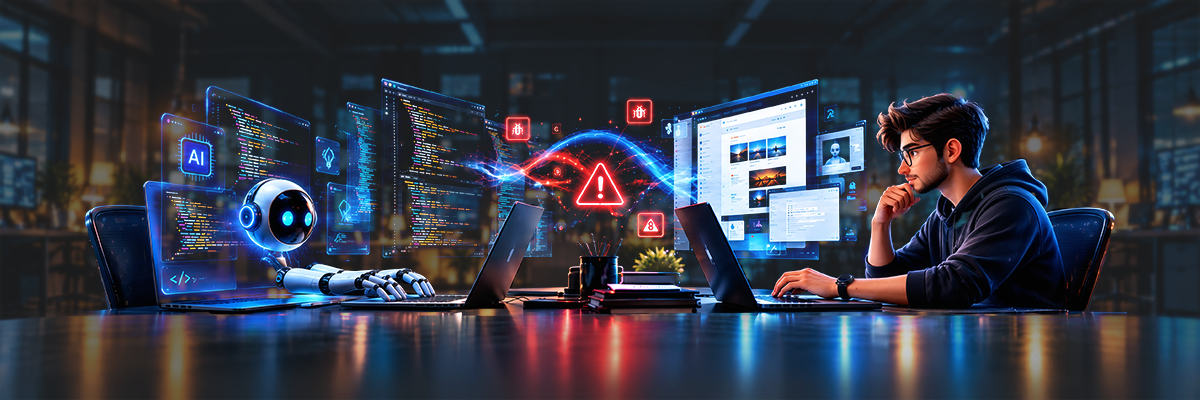
Vibe coding refers to the software development practice that allows natural-language prompts to drive artificial intelligence to generate, optimize, and improve code. It helps developers utilize tools to write instructions without having to type every single line of code. The generated output may range from entire functions and applications, databases, queries, interfaces, or configuration files. Such approach has attracted much attention as AI tools become capable of assisting in various stages of the software development process.
For web developers, mobile application developers, and other software developers, vibe coding can make their monotonous work less time-consuming. At the same time, the speed of code generation concerns security, quality, testing, and long-term maintenance.
Why Is Vibe Coding Becoming Popular?
The growing use of AI-assisted development is primarily motivated by the speed and convenience it offers. Developers can voice a requirement and obtain a starting point without having to build everything from scratch. Some of the main reasons for its growing adoption include:
- Faster prototyping: Ideas can be converted into basic working prototypes in less time.
- Quick MVP development: AI can help create initial versions of products for testing and validation.
- Reduced repetitive coding: Common functions and codes can be generated quickly.
- Easier experimentation: Developers can test different approaches without writing everything manually.
- Support with unfamiliar technologies: AI can provide examples and code suggestions when working with unfamiliar frameworks, libraries, or programming languages.
Major Risks and Disadvantages of Vibe Coding
A) Security Vulnerabilities
One of the main problems associated with the AI-assisted development is security. If the prompt does not include security requirements or if the implementation of the solution is not validated, AI code may contain vulnerabilities.
Common concerns include:
- Weak authentication and access-control mechanisms
- Insecure handling of user and application data
- Improper input validation
- Injection vulnerabilities
- Exposed credentials or sensitive configuration
- Unsafe third-party dependencies
These issues can be significant when incorporating AI-generated code into a project, and it can create AI Coding security risks in many application components, if it fails to undergo rigorous security analysis.
B) Technical Debt and Storage Usage
The rapid code generation can create technical debt. The AI tools may lead to creation of additional files, implementation alternatives, or functions which may not be removed during future code modifications.
As projects grow, this can lead to:
- The appearance of duplicate or unnecessary code
- Excessive files and dependencies
- Larger project repositories
- Increased storage requirements
- Higher infrastructure and backup costs
- Additional maintenance work
Storage can become practical concern, when there are more applications that need to store codes, dependencies, files, logs, or test data, especially if the projects are large. It can also grow costly if apps require bigger servers, databases, backups, or cloud storage.
C) Code Quality and Maintainability
It is possible that the generated code may be correct for a particular requirement, but it still can be quite hard to maintain. Furthermore, different prompts could produce different coding patterns, leading to inconsistency within the same project.
Some common concerns include:
- Inconsistent coding styles across different files
- Duplicate functions or unnecessary code
- Limited or unclear documentation
- Poorly structured code that affects scalability
- Performance issues caused by inefficient implementations
D) Reduced Understanding of Code
Another concern is that developers may become dependent on generated solutions without fully examining how they work. This can create difficulties when a generated component needs modification or when an unexpected problem appears.
This can lead to issues such as:
- Difficulty explaining how specific code functions
- Problems modifying AI-generated components
- Longer troubleshooting when errors occur
- Difficulty identifying the root cause of failures
- Reduced familiarity with the application’s internal logic
- Greater dependence on AI for future code changes
E) Debugging and Testing Challenges
AI-generated code can introduce unexpected interactions between different parts of an application. It is entirely possible that a function that worked fine on its own will fail when merged with the rest of the application. Thorough testing is therefore important.
Developers may need to perform:
- Unit testing
- Integration testing
- Security testing
- Performance testing
- Code review
- Manual validation of important application functions
F) Overdependence on AI
Excessive reliance on Artificial Intelligence affect how developers approach technical problem. If AI becomes the default solution for every programming challenges, it can hinder the amount of practice developers get in relation to core programming concepts and their personal approach to problem-solving.
This overdependence can also result in:
- Less independent problem-solving and analytical thinking
- Difficulty handling problems when AI suggestions are incorrect
- Greater reliance on AI for architectural and technical decisions
- Limited ability to evaluate whether generated solutions are appropriate
Human Oversight in AI-Assisted Development
AI can generate code, but a software development contains number of other elements. Human developers are required to make decisions regarding the interaction between various components and whether a given implementation will be suitable for the intended purpose.
Web app developers and other software professionals can continue to play important roles in such areas as:
- Making architectural decisions
- Reviewing and validating generated code
- Identifying security and performance problems
- Translating business requirements into technical solutions
- Handling complex debugging
- Maintaining consistent coding practices
- Ensuring scalability and long-term maintainability
- Managing production systems and resolving unexpected issues
The role of Mobile app developers also extends beyond writing application code. They need to make sure that application works on various devices, interactions are intuitive, adhere to the constraints of the target platform, and consider performance, data usage, and behaviour of their application on different environments.
AI can generate a possible implementation, but developers provide the technical judgment required to determine whether that implementation is appropriate. Their experience also helps teams recognise problems that may not be obvious from the generated output alone.
Keeping Human Expertise at the Core
Vibe coding tends to change the way software applications can be developed by making code generation faster and enabling developers to proceed faster from an idea to the initial implementation. It can be applied in various scenarios, including prototyping, repetitive tasks, and other development activities.
However, speed should not take precedence over engineering practices as there could be possible drawbacks, including security concerns, technical debt, and complexity during the maintenance and debugging processes due to the improper review and of the automatically generated code.
AI can help developers during the process, making it more productive and less error-prone. However, it should not compromise the critical thinking and judgement of a software developer that can balance reliability and security to meet long-term requirements.